
Pressure Cleaning Brisbane
Brisbane's problem is shade and humidity together. A driveway on the southern side of a house, or a path under a jacaranda, never fully dries out between wet seasons, and what grows there is mould, algae and lichen rather than dirt. Pressure alone knocks the top off it and it is back within months. The other Brisbane specialty is stairs and retaining walls — Queenslanders come with a lot of both, they are the hardest surfaces to clean evenly, and they are usually the first thing a visitor sees. Unit block paths and common driveways round out most of what we are called to in the inner suburbs.
Mon to Sun, 7:00am – 9:00pm — weekends included at no extra charge
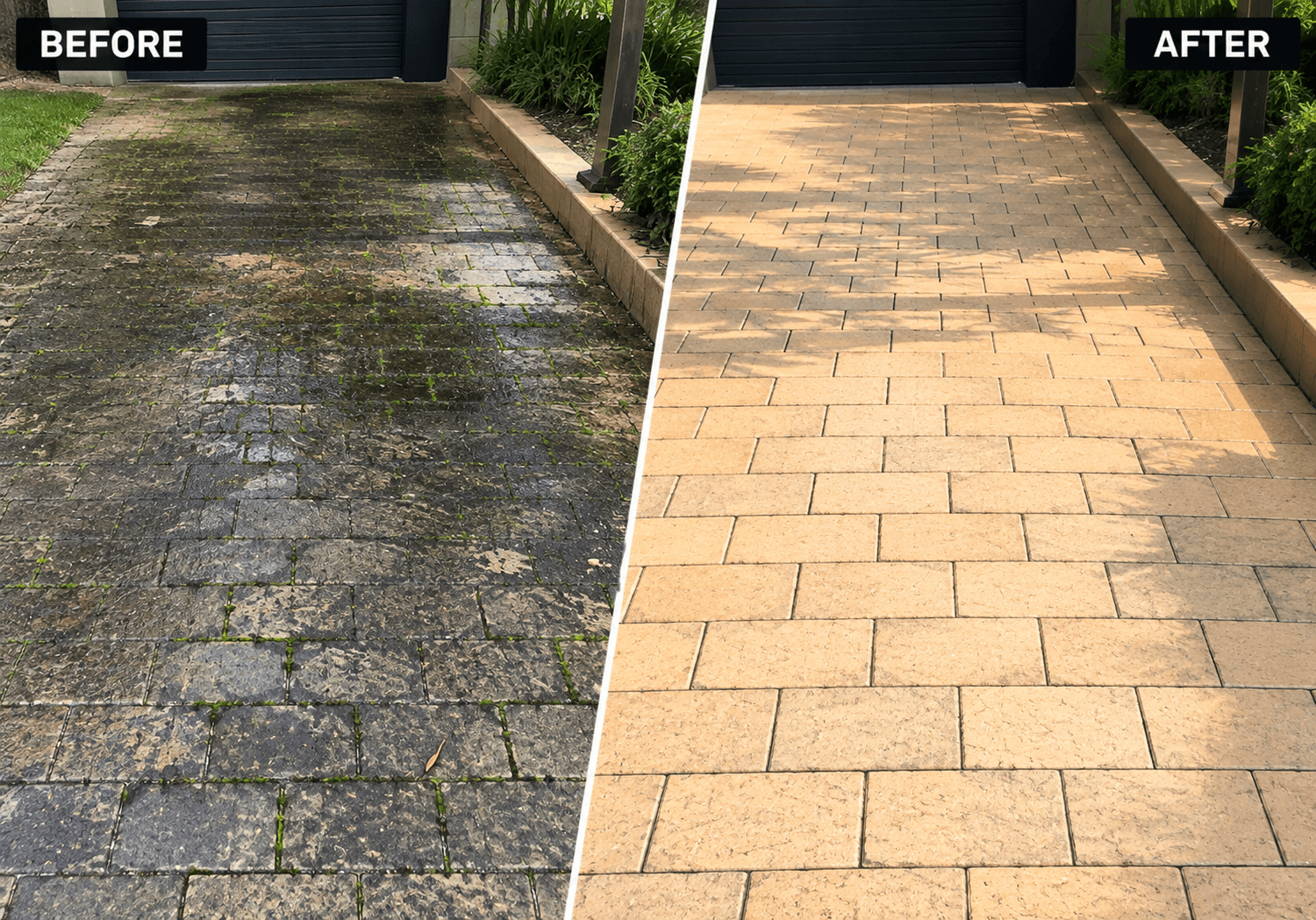
What we get called out for in Brisbane
- Shaded southern-side driveways and paths where mould and lichen return within months of a wash that did not treat them
- Queenslander stairs, landings and retaining walls, done by hand at the edges where a machine cannot hold a line
- Unit block driveways, common paths and bin areas, quoted per building for body corporates
The method itself is the same wherever we take it — the full pressure cleaning process is set out on the service page, and everything we cover in this region is on the Brisbane page.
Pressure Cleaning across Brisbane
Every suburb below, plus the ones around them. If yours is not listed, send it to us on WhatsApp and we will confirm before you book.
Postcodes: 4000, 4005, 4006, 4007, 4011, 4030, 4032, 4034, 4051, 4053, 4059, 4064, 4066, 4067, 4068, 4069, 4075, 4101, 4102, 4103, 4105, 4109, 4120, 4121, 4122, 4151, 4152, 4169, 4170, 4171, 4178
- Brisbane CBD
- West End
- South Brisbane
- Highgate Hill
- Woolloongabba
- Kangaroo Point
- East Brisbane
- Fortitude Valley
- New Farm
- Newstead
- Teneriffe
- Bowen Hills
- Albion
- Hamilton
- Ascot
- Clayfield
- Hendra
- Nundah
- Windsor
- Wooloowin
- Lutwyche
- Kedron
- Chermside
- Aspley
- Carseldine
- Zillmere
- Stafford
- Everton Park
- Mitchelton
- Alderley
- Grange
- Wilston
- Newmarket
- Enoggera
- Kelvin Grove
- Red Hill
- Paddington
- Milton
- Ashgrove
- The Gap
- Toowong
- Auchenflower
- St Lucia
- Taringa
- Indooroopilly
- Chelmer
- Kenmore
- Chapel Hill
- Brookfield
- Sherwood
- Graceville
- Corinda
- Oxley
- Annerley
- Fairfield
- Yeronga
- Moorooka
- Salisbury
- Sunnybank
- Macgregor
- Greenslopes
- Holland Park
- Tarragindi
- Coorparoo
- Camp Hill
- Carina
- Carindale
- Mount Gravatt
- Mansfield
- Wishart
- Norman Park
- Morningside
- Cannon Hill
- Bulimba
- Hawthorne
- Balmoral
- Wynnum
- Manly
- Lota
What happens on the day in Brisbane
We check the surface
Concrete, pavers and sandstone each need a different pressure.
Mould treated
We kill it first, so it doesn’t grow straight back.
Area protected
Garden beds, gutters and downpipes covered before we start.
Even machine wash
A rotary cleaner gives one even finish, with no stripes.
Edges and joints
Corners done by hand, and paver joints re-sanded.
Pressure Cleaning in Brisbane — your questions
Anything not covered here, message us and we’ll answer in plain English.
Ask on WhatsAppWhy is only one side of my driveway green?
Shade. The side that gets sun dries out between rain events and the mould cannot establish; the side that stays damp under a tree or against a fence is a permanent growing surface. You can clean it as often as you like and it will keep coming back on that side alone, which is why we treat biologically first and kill it at the root rather than washing off the visible growth.
Will pressure cleaning damage the render or the paint on my house?
At full pressure, yes — it will strip render, blast paint off weatherboards and force water in behind cladding, and that is a genuinely expensive mistake. Anything that is not concrete gets a lower pressure and a different method. If you want the house itself washed rather than the ground around it, say so at the quote, because it is a different job with different equipment.
Why does the mould come straight back after a pressure clean?
Because pressure alone only knocks the top off it. Most of what looks like dirt on Queensland concrete is biological — mould, algae and lichen living on moisture in the shade — and the root system stays in the surface after the visible growth is blasted away. We put a treatment down that kills it first and then wash, which is why our work stays clean noticeably longer than a wash on its own.
Will pressure cleaning damage my pavers, sandstone or render?
It will if the pressure is wrong, and this is where most damage happens. Full pressure strips render, destroys sandstone, forces water behind cladding and blows the sand straight out of paver joints. We match the pressure and the method to the surface, and re-sand paver joints afterwards where the wash has opened them up.