
Strip & seal for vinyl, VCT and sealed concrete across South East QLD
Spent coatings and years of build-up taken back to the bare floor, then sealed again from scratch.
Not sure this is the right fix? Send a photo on WhatsApp and we’ll tell you.
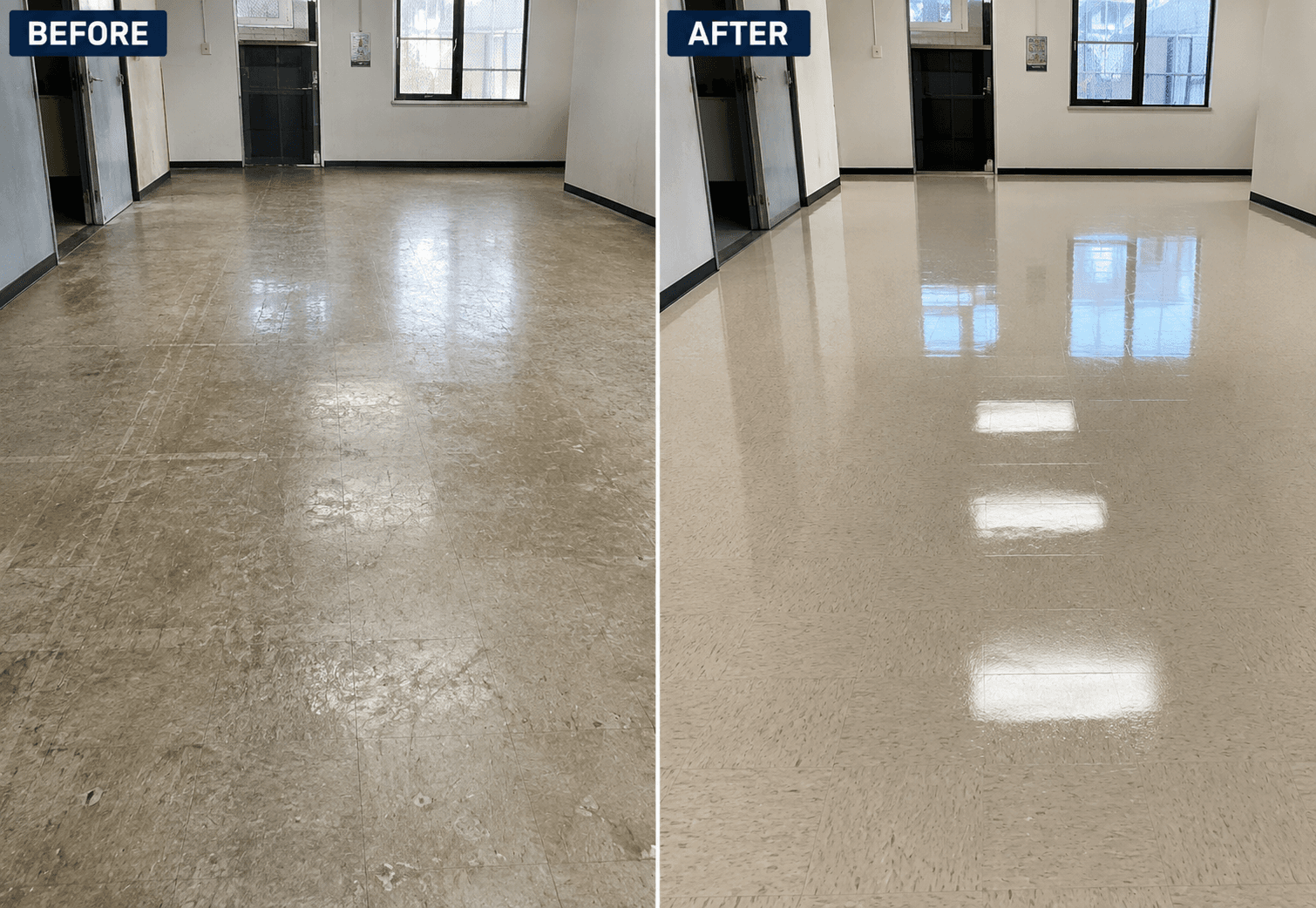
What strip & seal actually involves
What looks like a worn-out floor is usually a worn-out finish. Sealer is sacrificial — it is there to take the traffic so the vinyl or concrete underneath does not — and once it has been walked through, scuffed and polished thin, mopping cannot bring it back, because the layer you are cleaning has already gone. Stripping takes the spent coating off entirely and starts again on the bare floor.
It suits the floors that were built to carry a coating: vinyl and VCT, lino, sealed concrete and some sealed tile. It is not the answer to everything. Unsealed timber wants sanding, not stripping, and a floor that is gouged, cupped or delaminating will still be gouged, cupped and delaminating under a fresh coat of sealer. We tell you which of those you have at the assessment, not after the invoice.
The part worth knowing before you book is the timeline. Stripper needs dwell time, the floor has to be neutralised and properly dry before sealer goes anywhere near it, and every coat has to cure before the next one goes on — commonly three to five coats, depending on the floor and the traffic it carries. Rushing any of that is what produces the milky, peeling finish you see in tired shopping-centre corridors. You get a realistic window from us, and the earliest hour the floor can take foot traffic again.
Most of this work is commercial and most of it happens when the site is shut. We schedule overnight, at weekends and through shutdown periods for offices, medical centres, childcare, schools, retail, warehouses and strata common areas — and where an area cannot be closed off in one go, we work it in sections.
Available across Brisbane, Gold Coast, Ipswich, Logan and the Sunshine Coast, seven days a week, 7am–9pm, incl. weekends.
What happens on the day
Seven steps, start to finish. Same either way — home or commercial.
Assessment
We identify the floor, the coating on it, and what condition it is really in.
Area prepared
Fittings moved, skirtings and drains masked, the area closed off.
Strip
Stripper goes down, gets its dwell time, then the old coating comes off.
Deep clean
The bare floor is scrubbed, the slurry extracted, the surface neutralised.
Dry and check
We moisture-check it. Sealer over a damp floor is what goes milky.
Seal
Three to five coats, each one cured before the next goes on.
Final inspection
We walk it with you and say when it can take foot traffic again.
Strip & Seal in your region
Strip & Seal — your questions
Still unsure? Message us and we’ll answer in plain English.
Ask on WhatsAppHow long does a strip and seal take, and when can we walk on it?
The strip and the deep clean are the fast part. What sets the timeline is curing: the floor has to be neutralised and properly dry before any sealer goes on, and each of the three to five coats has to cure before the next. A typical office suite is an overnight job; a large site is staged across a weekend or a shutdown. Light foot traffic is usually possible several hours after the last coat, and we give you the exact hour before we leave rather than a guess.
Which floors can be stripped and sealed?
The ones built to carry a coating: vinyl sheet and VCT, lino, sealed concrete and some sealed tile. Unsealed timber wants sanding, not stripping. And a floor that is gouged, cupped or delaminating will still be gouged, cupped and delaminating under new sealer — a fresh coat makes a tired floor look new, but it does not repair one. We identify which you have at the assessment.
Why do some sealed floors go milky or peel?
Almost always because sealer went onto a floor that was still damp, or a coat went on before the one under it had cured. Both are what happens when a job is rushed to hand a site back early. It is why we moisture-check the bare floor and cure between coats, and why we would rather quote a realistic window than the fastest one.
Can you work overnight or during a shutdown?
That is how most of this work happens. Offices, medical centres, childcare, schools, retail, warehouses and strata common areas are done after close, at weekends or through a shutdown period. Where an area cannot be closed off in one go, we work it in sections so part of the floor is always available.